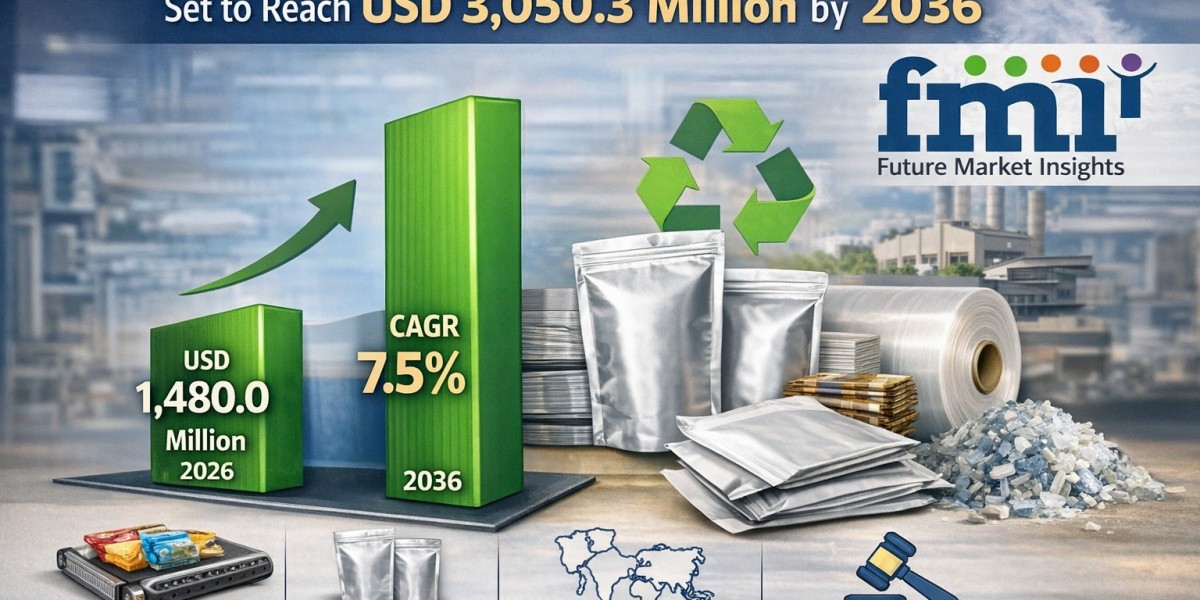

The global Post-Industrial Recyclate (PIR) Flexible Packaging Market is projected to experience steady expansion as industries intensify efforts to reduce virgin polymer consumption and integrate recycled materials into packaging systems. The market is estimated to reach USD 1,480.0 million in 2026 and is forecast to grow to USD 3,050.3 million by 2036, advancing at a compound annual growth rate (CAGR) of 7.5% during the forecast period.
Quick Stats: Post-Industrial Recyclate (PIR) Flexible Packaging Market (2026–2036)
• Market Value (2026): USD 1,480.0 Million
• Forecast Value (2036): USD 3,050.3 Million
• CAGR: 7.5%
• Leading Segment: Snacks, Confectionery & Food (40% Share)
• Key Product Segment: PIR-based Laminated Pouches (45% Share)
• Fastest-Growing Countries: India, China, United States, Brazil, Germany
• Key Growth Driver: Increasing regulatory pressure to incorporate recycled content in packaging materials
Structural Growth Driver: Regulatory Push for Recycled Content in Packaging
One of the primary drivers shaping the Post-Industrial Recyclate (PIR) flexible packaging market is the intensifying regulatory framework targeting plastic waste reduction and recycled content adoption. Governments across major economies are implementing plastic taxes, extended producer responsibility (EPR) schemes, and recycled content mandates, which incentivize manufacturers to reduce dependence on virgin fossil-based polymers.
Key regulatory and industry standards influencing the market include:
• Recycling regulations promoting circular material flows
• Certification requirements for recycled content traceability
• Sustainable packaging guidelines across global retail chains
• Extended Producer Responsibility (EPR) frameworks
• Industrial material recovery and waste reduction policies
From Compliance to Industry Transformation
The increasing regulatory pressure is driving a structural transformation across the flexible packaging value chain. Manufacturers are no longer treating industrial scrap as a low-value byproduct but are instead integrating advanced recycling systems directly within their manufacturing facilities. This shift enables packaging converters to maintain control over raw material supply while improving cost efficiency and environmental performance.
Packaging manufacturers are prioritizing:
• Sustainability performance and recycled content integration
• Cost efficiency through internal material recovery
• Recyclability of flexible packaging structures
• Operational compatibility with existing packaging lines
Technology Transformation: Advanced Reprocessing and Filtration Systems
Technological innovation is enabling the Post-Industrial Recyclate flexible packaging sector to transition from low-value applications toward high-performance packaging solutions. Modern extrusion systems now integrate advanced melt filtration, vacuum degassing technologies, and high-precision extrusion processes that remove impurities and maintain the optical clarity of recycled films.
These innovations allow manufacturers to produce thin-gauge flexible films with mechanical and barrier properties comparable to virgin plastics. Additionally, the growing adoption of mono-material polyethylene and polypropylene structures is improving recyclability and enabling easier re-extrusion of industrial scrap without complex
compatibilization processes.
Key innovation areas shaping the market include:
• Advanced material development for recycled films
• Automation integration in recycling systems
• Lightweight film design for material efficiency
• Sustainable material engineering for mono-material packaging
• Manufacturing efficiency improvements in extrusion processes
Segment Highlights
By Material Type
• PIR-PE and PIR-PP (50% share): Widely used due to compatibility with flexible packaging extrusion processes and ease of reprocessing.
• PIR Mono-PE Structures: Increasingly adopted for recyclable packaging designs.
• PIR-PE Blends: Used to improve mechanical strength and barrier properties.
• Polypropylene PIR Films: Favored in applications requiring higher heat resistance.
• Multi-layer PIR Structures: Utilized for specialized barrier packaging formats.
By Application / Product Type
• Snacks, Confectionery & Food (40% share): Leading segment due to strict hygiene standards and strong adoption of PIR laminated pouches.
• Pet Food & Personal Care Packaging: Increasing adoption of flow-wrap films and mono-PE PIR films.
• E-commerce & FMCG Packaging: Growing demand for courier bags and mailer films made from recycled materials.
• Household & Value FMCG: Cost-efficient PIR pouches gaining traction in emerging markets.
• Regional Packaging Applications: Used for secondary packaging and logistics films.
Regional Outlook: Emerging Economies Drive Adoption
Global demand for Post-Industrial Recyclate flexible packaging is witnessing varied growth patterns across regions. Rapid industrial expansion and manufacturing output in Asia are accelerating the availability of industrial scrap for recycling, while developed markets in North America and Europe are primarily driven by regulatory compliance and sustainability commitments.
Country-level growth projections include:
• India (11.5% CAGR): Strong export manufacturing and expanding e-commerce packaging demand drive PIR adoption.
• China (10.2% CAGR): Large industrial base generates consistent recyclable feedstock for flexible packaging production.
• Brazil (8.0% CAGR): Retail expansion and consumer goods packaging demand support PIR pouch growth.
• Germany (6.5% CAGR): Advanced manufacturing infrastructure supports high-quality industrial scrap recovery.
• United States (6.9% CAGR): Robust packaging production and sustainability initiatives drive recycled film demand.
Risk Landscape: Market Constraints and Challenges
Despite strong growth potential, the Post-Industrial Recyclate flexible packaging market faces several structural challenges related to traceability, certification, and supply chain integration. Ensuring accurate verification of recycled content remains a major concern for regulatory compliance and industry standardization.
Key challenges include:
• Raw material price volatility affecting virgin polymer alternatives
• Supply chain disruptions in recycled material sourcing
• Infrastructure gaps in industrial recycling facilities
• Regulatory complexity across global markets
• High manufacturing costs for advanced reprocessing technologies
Competitive Landscape: Key Market Players
The competitive landscape of the Post-Industrial Recyclate flexible packaging market is characterized by strategic investments in recycling infrastructure and vertical integration strategies. Major packaging manufacturers are developing proprietary recycling ecosystems to secure high-quality feedstock and strengthen supply chain control.
Top key companies include:
• Amcor plc
• Berry Global Group, Inc.
• Sealed Air Corporation
• Mondi Group
• Huhtamaki Oyj
Other notable companies include GreenPak, Hengli Group, Constantia Flexibles, UFlex Ltd., Printpack, Coveris, and ProAmpac.
Outlook: Future of the Post-Industrial Recyclate (PIR) Flexible Packaging Market
The future of the Post-Industrial Recyclate flexible packaging market will be shaped by regulatory policies, material science innovation, and expanding circular economy frameworks. As global brands commit to sustainability targets for 2030 and beyond, the integration of high-quality recycled materials into packaging systems will become a core industry priority.
Key future growth drivers include:
• Technology advancement in recycling and extrusion
• Sustainability initiatives across global packaging supply chains
• Manufacturing expansion in emerging economies
• Supply chain innovation and closed-loop recycling systems
For an in-depth analysis of evolving industry trends and to access the complete strategic outlook for the market through 2036, visit the official report page at: https://www.futuremarketinsights.com/reports/post-industrial-recyclate-pir-flexible-packaging-market