
Sustainable Packaging Market Set to Reach USD 421.6 Billion by 2036 as Regulatory Pressure and Circular Economy Adoption Accelerate
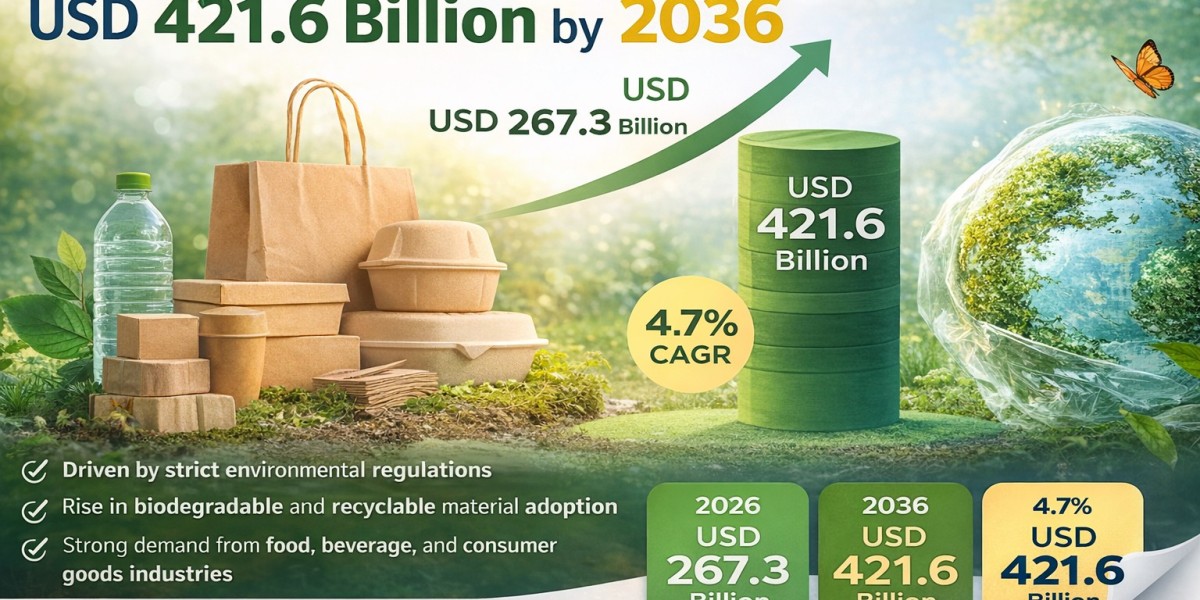
The global sustainable packaging market is entering a decisive growth phase as governments tighten environmental regulations and manufacturers accelerate the transition toward circular packaging systems. Valued at USD 267.3 billion in 2026, the market is projected to reach USD 421.6 billion by 2036, expanding at a CAGR of 4.7%, according to the latest industry analysis.
Unlike earlier sustainability initiatives that focused mainly on recycling awareness, the 2026–2036 outlook reflects a structural shift driven by stricter regulatory mandates, rising environmental accountability, and the integration of biodegradable and renewable packaging materials into mainstream supply chains.
Government regulations increasingly focus on waste reduction standards, recyclability requirements, and environmental compliance for packaging materials, ensuring that eco-friendly containers used in food storage, consumer goods packaging, and product preservation maintain both environmental performance and product integrity.
Quick Stats: Sustainable Packaging Market (2026–2036)
• Market Value (2026): USD 267.3 Billion
• Forecast Value (2036): USD 421.6 Billion
• CAGR: 4.7%
• Leading Material Type: Bio-based Packaging (43.8%)
• Key Product Segment: Flexible Packaging (38.7%)
• Fastest-Growing Countries: India, China, Brazil, Germany, U.S.
• Key Growth Driver: Circular economy initiatives and biodegradable material adoption
Structural Growth Driver: Regulatory Push for Waste Reduction
Government policies and environmental frameworks are emerging as the strongest structural force behind sustainable packaging adoption. Regulatory authorities require testing and certification of packaging materials before manufacturing, import, sale, or distribution, ensuring compliance with environmental protection standards.
National and international regulations mandate alignment with recognized sustainable packaging standards, including:
- Biodegradable material application guidelines
- Compostability certification requirements
- Renewable content specifications
- Recycling compatibility standards
Compliance with these frameworks helps maintain environmental protection across global supply chains while ensuring consistent performance outcomes for manufacturers, retailers, and logistics providers.
Environmental impact regulations also limit material sourcing practices, requiring packaging systems to meet ecosystem protection standards during production and disposal. This includes biodegradable treatments, renewable raw material utilization, and waste reduction measures designed to minimize environmental contamination.
From Compliance to Circular Economy Integration
While regulatory compliance establishes baseline demand, industry value creation increasingly centers on circular economy integration and sustainable material innovation.
Manufacturers across food processing, consumer goods production, and retail packaging systems are adopting eco-friendly containers that support waste reduction while maintaining operational efficiency.
Packaging selection now prioritizes:
- Biodegradability performance
- Recyclability compatibility
- Waste reduction efficiency
- Environmental lifecycle impact
Food and consumer goods manufacturers depend on packaging systems that can maintain product quality while aligning with sustainability targets and evolving environmental protocols.
Large-scale packaging operations are increasingly adopting bio-based and recycled content platforms, allowing companies to maintain environmental performance during disposal processes while preserving cost-effective packaging characteristics.
Technology Transformation: Materials Innovation and Sustainable Design
The next decade of sustainable packaging innovation will be shaped by advances in material science, recyclable design architectures, and biodegradable coating technologies.
Key innovation areas include:
• Bio-based container designs derived from renewable resources
• Advanced biodegradable coatings for improved environmental compatibility
• Recyclable packaging systems supporting circular economy models
• Lightweight flexible packaging reducing material consumption
• Integration with modern filling, sealing, and waste management infrastructure
Manufacturers are also evaluating packaging systems based on storage performance, environmental durability, and compatibility with existing manufacturing equipment, ensuring seamless integration with established packaging operations.
Segment Highlights
By Material Type
• Bio-based Packaging (43.8% share): Dominant due to strong adoption in food containers, consumer goods packaging, and biodegradable applications.
• Recycled Content Packaging (31.2% share): Supports circular economy programs and waste reduction initiatives across multiple industries.
• Renewable Material Packaging (18.4% share): Increasingly used for compostable products, organic food packaging, and environmentally premium solutions.
• Other Materials (6.6% share): Used in specialized environmental packaging applications.
By Product Type
• Flexible Packaging (38.7% share): The leading segment due to lightweight construction and strong recyclability potential.
• Rigid Packaging (29.4% share): Preferred for applications requiring durability and product protection.
• Paperboard Packaging (21.3% share): Widely used in food packaging and consumer goods requiring biodegradable materials.
• Glass Packaging (7.8% share): Favored for premium and reusable container applications.
• Other Packaging Types (2.8% share): Includes niche and specialized environmental packaging solutions.
Regional Outlook: Emerging Economies Drive Adoption
Global demand for sustainable packaging is increasing as food and consumer goods manufacturers expand production capacity while addressing environmental compliance and recyclability requirements.
Key country-level growth projections include:
• India (6.2% CAGR): Growth supported by expansion of food processing industries and biodegradable packaging adoption.
• China (5.8% CAGR): Manufacturing expansion and government environmental policies driving adoption.
• Brazil (5.1% CAGR): Increased use in food packaging, agricultural containers, and biodegradable packaging systems.
• Germany (4.3% CAGR): Strong environmental regulations and advanced manufacturing capabilities supporting sustainable packaging demand.
• United States (4.0% CAGR): Adoption driven by environmental standards and performance-based packaging protocols.
Asia-Pacific is expected to contribute significantly to incremental growth as food processing industries and consumer goods manufacturing expand across emerging markets.
Risk Landscape: Cost Pressures and Infrastructure Gaps
Despite steady growth prospects, the sustainable packaging market faces several structural challenges:
• Fluctuations in bio-based raw material pricing
• Limited availability of recycled content in some regions
• Variations in waste management and recycling infrastructure
• Higher production costs associated with specialized biodegradable materials
Manufacturers must balance environmental performance, material cost management, and supply chain reliability when implementing sustainable packaging strategies across diverse manufacturing regions.
Competitive Landscape: Global Leaders Scaling Sustainable Solutions
The sustainable packaging market remains competitive, with major packaging companies investing heavily in environmentally responsible packaging technologies and circular supply chain systems.
Leading players include:
• Amcor plc
• Mondi Group
• Tetra Pak International S.A.
• Smurfit Kappa Group
• International Paper Company
Other notable companies include Berry Global Group Inc., Sealed Air Corporation, WestRock Company, Huhtamaki Oyj, and Constantia Flexibles Group GmbH.
Competition increasingly focuses on environmental material innovation, supply chain reliability, recyclability compatibility, and integration with manufacturing operations.
Outlook: Sustainable Packaging Becomes an Industry Standard
By 2036, sustainable packaging is expected to evolve from a compliance-driven environmental initiative into a core industrial strategy across global manufacturing ecosystems.
Future growth will be supported by:
• Expansion of circular economy packaging systems
• Rising use of bio-based and renewable materials
• Integration of recyclable and biodegradable packaging technologies
• Growing environmental accountability in consumer goods supply chains
For an in-depth analysis of evolving formulation trends and to access the complete strategic outlook for the Market through 2036, visit the official report page at: https://www.futuremarketinsights.com/reports/sustainable-packaging-market