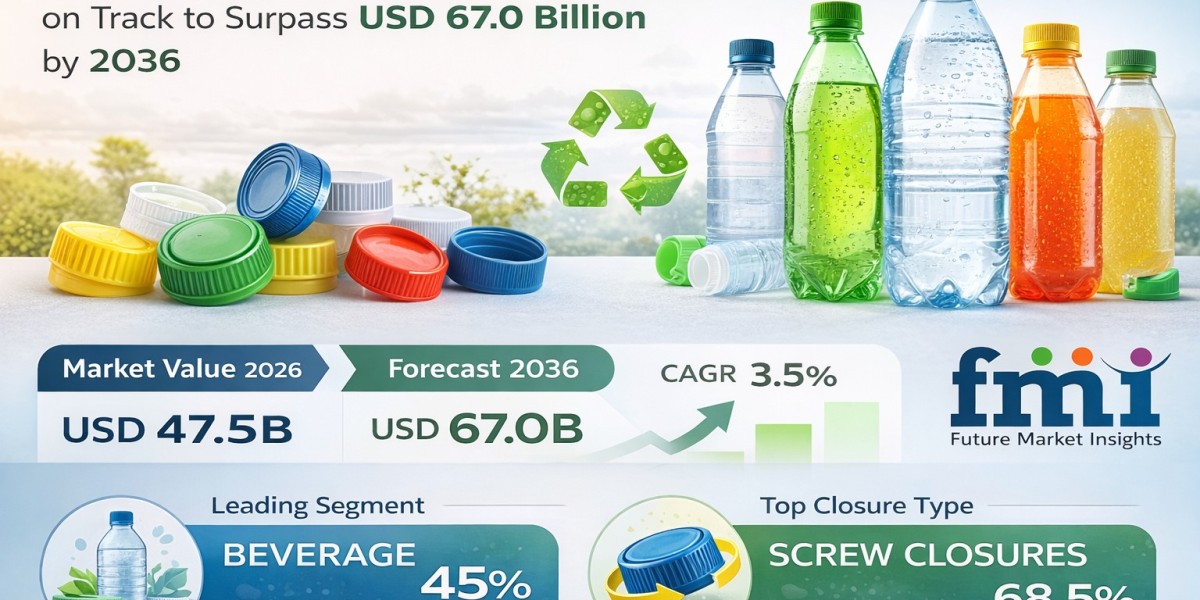

The global plastic caps and closures market is entering a period of steady structural expansion, supported by rising demand for lightweight, convenient, and cost-efficient packaging solutions across the global FMCG sector. Valued at USD 47.5 billion in 2026, the market is projected to reach USD 67.0 billion by 2036, expanding at a CAGR of 3.5%, according to the latest analysis by Future Market Insights (FMI).
Unlike earlier growth phases that focused primarily on volume supply for bottled beverages, the 2026–2036 outlook reflects a dual transformation: scaling production for high-volume beverage packaging while simultaneously shifting toward sustainable materials, lightweight designs, and intelligent closures that enhance functionality and recyclability.
Quick Stats: Plastic Caps and Closures Market (2026–2036)
• Market Value (2026): USD 47.5 Billion
• Forecast Value (2036): USD 67.0 Billion
• CAGR: 3.5%
• Leading Closure Type: Screw Closures (68.5%)
• Leading End-Use Segment: Beverage (45%)
• Dominant Material Category: Thermoplastics (75.3%)
• Key Growth Regions: China, Brazil, Germany
• Major Industry Players: Berry Global Inc., Amcor Plc, Silgan Plastics, Aptar Inc., Bericap GmbH & Co KG
Structural Growth Driver: Global Expansion of Packaged Beverage Consumption
Growing consumption of bottled water, carbonated drinks, and functional beverages continues to underpin demand for plastic caps and closures worldwide. High-volume bottling operations depend on reliable sealing systems capable of maintaining product integrity, carbonation retention, and shelf stability.
Rapid urbanization and increasing disposable incomes in emerging economies are accelerating adoption of packaged food and beverage products. At the same time, expanding retail networks and convenience-focused consumption habits are encouraging FMCG brands to invest in durable, easy-to-open, and resealable closure solutions.
Government initiatives promoting food safety standards have also strengthened demand for tamper-evident closures, ensuring product security across retail supply chains.
Sustainability Shift: PCR Resins and Circular Packaging
One of the most significant transformations shaping the market is the transition from virgin polymers to post-consumer recycled (PCR) resins.
Consumer goods companies are redesigning packaging strategies to align with global sustainability mandates and circular economy principles. As a result, packaging suppliers are introducing eco-friendly closures manufactured using recycled thermoplastics while maintaining structural integrity and food-grade compliance.
Key sustainability trends influencing procurement strategies include:
• Adoption of mono-material packaging systems for easier recycling
• Integration of PCR resin content in closure manufacturing
• Design-for-recycling initiatives across beverage packaging ecosystems
• Lightweight closures reducing overall plastic consumption
These initiatives are driving innovation among molders, who are increasingly leveraging advanced compression molding technologies to produce high-performance sustainable closures.
Technology Transformation: Automation, Lightweighting, and Smart Closures
Innovation in closure manufacturing is increasingly centered on efficiency and functionality. Over the next decade, several technology trends are expected to reshape the industry landscape:
• Lightweight closure designs utilizing thinner yet stronger plastic walls
• Short-neck bottle finishes enabling material reduction and cost efficiency
• Advanced hot-runner molds minimizing sprue waste and improving productivity
• Automation and robotics integration improving operational efficiency and EBITDA margins
• Smart closures with QR codes or NFC tags enabling traceability and consumer engagement
These technological advancements allow manufacturers to reduce resin consumption while maintaining sealing performance, a critical factor as raw material costs fluctuate.
Segment Highlights
By Cap Type
• Screw Closures (68.5% share in 2026):
Dominant due to universal compatibility with bottle preforms and reliable sealing for carbonated beverages and bottled water.
• Push-Pull and Snap Closures:
Increasing adoption in sports drinks, condiments, and pharmaceutical packaging due to convenience and dispensing functionality.
By End-Use Industry
• Beverage (45% share):
Primary revenue contributor driven by massive global production of bottled water, soft drinks, and ready-to-drink beverages.
• Food and Personal Care:
Growth driven by demand for dispensing caps in condiments, sauces, cosmetics, and hygiene products.
• Pharmaceutical Applications:
Increasing use of child-resistant and tamper-evident closures for regulatory compliance.
Emerging Innovation: Tethered Caps and Regulatory Compliance
Tethered closures are gaining strong momentum as global regulators seek to reduce plastic litter and improve recycling rates. These designs ensure that caps remain attached to bottles after opening, preventing loose cap pollution.
The adoption of tethered caps has accelerated particularly in European beverage packaging, where regulatory directives mandate their use for many single-use plastic bottles.
Manufacturers are responding by developing ergonomic tethered sport caps and snap-lock closure designs that maintain consumer convenience while complying with environmental regulations.
Regional Outlook: Emerging Markets Lead Volume Growth
Global demand for plastic caps and closures reflects diverse regional dynamics shaped by consumption patterns and regulatory frameworks.
• China (5.6% CAGR):
Expanding beverage production and high-speed bottling investments supporting closure demand.
• Brazil (4.5% CAGR):
Strong growth driven by vibrant beverage consumption and personal care packaging markets.
• Germany (4.0% CAGR):
Innovation hub for tethered caps and circular packaging technologies under strict EU sustainability mandates.
• United States (3.8% CAGR):
Demand fueled by mature FMCG sector emphasizing convenience, dispensing functionality, and child-resistant packaging.
• Canada (3.0% CAGR):
Growth supported by government initiatives promoting recyclable packaging and plastic waste reduction.
Asia-Pacific remains the fastest-growing production hub due to large-scale manufacturing capacity and expanding middle-class consumer bases.
Risk Landscape: Resin Volatility and Sustainability Compliance
Despite steady growth prospects, the plastic caps and closures market faces several operational and regulatory challenges:
• Volatility in polypropylene and polyethylene resin prices
• Stricter sustainability regulations affecting virgin plastic usage
• Rising energy and operational costs in manufacturing
• Supply chain complexity in global beverage bottling networks
Manufacturers are mitigating these risks by investing in lightweighting technologies, automated production systems, and recycled material sourcing strategies.
Competitive Landscape: Scale, Sustainability, and Innovation
The global plastic caps and closures market remains moderately consolidated, with leading packaging conglomerates focusing on scale expansion and innovation.
Key industry participants include:
• Berry Global Inc.
• Amcor Plc
• Silgan Plastics
• Aptar Inc.
• Bericap GmbH & Co KG
• United Caps
• Closure Systems International Inc.
• Guala Closures S.p.A.
Berry Global currently holds a significant market presence, supported by its extensive global production network and strong partnerships with beverage manufacturers.
Companies are increasingly pursuing strategic acquisitions, regional manufacturing expansion, and collaborative product development with FMCG brands to strengthen market positioning.
Outlook: Closures Evolve from Commodity Components to Smart Packaging Platforms
By 2036, plastic caps and closures are expected to evolve beyond basic sealing mechanisms into value-added packaging components supporting sustainability, consumer engagement, and product security.
The next generation of closures will integrate:
• Circular packaging materials
• Smart digital authentication features
• Advanced dispensing functionality
• Material-efficient lightweight designs
As global FMCG brands intensify efforts toward sustainable packaging and interactive consumer experiences, plastic caps and closures are positioned to remain a critical component of modern packaging systems throughout the next decade.
For an in-depth analysis of evolving formulation trends and to access the complete strategic outlook for the Market through 2036, visit the official report page at: https://www.futuremarketinsights.com/reports/plastic-caps-and-closures-market