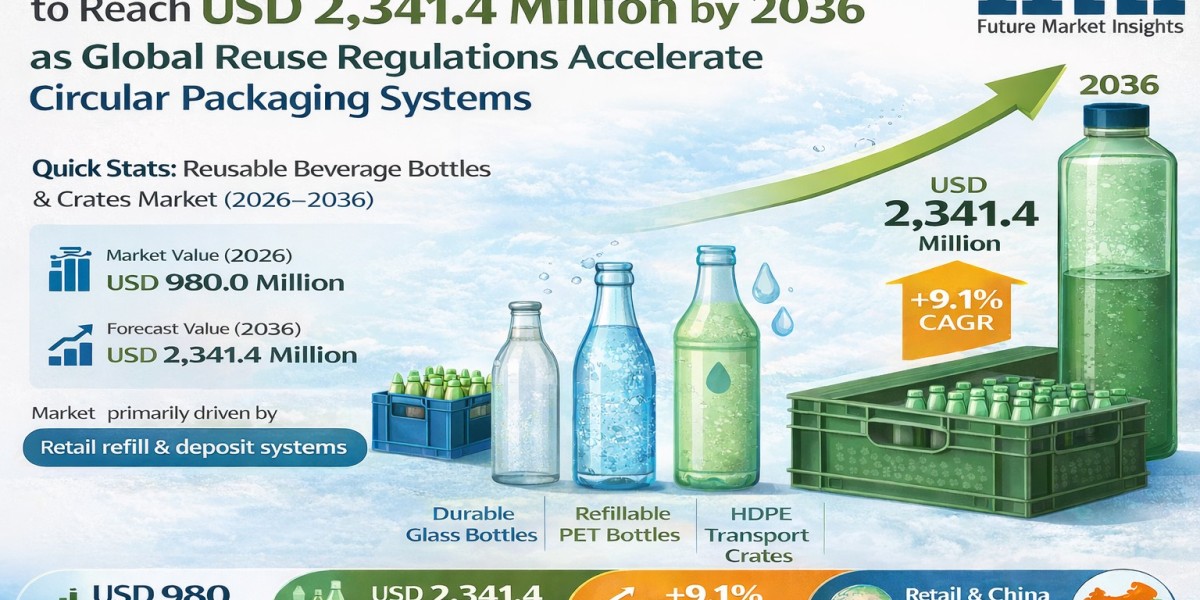

The global reusable beverage bottles & crates market is entering a decade of accelerated transformation as sustainability policies shift industry focus from recycling toward reuse-based packaging systems. Valued at USD 980.0 million in 2026, the market is projected to reach USD 2,341.4 million by 2036, expanding at a CAGR of 9.1%, according to industry analysis.
The market includes durable glass bottles, refillable PET containers, and high-density polyethylene (HDPE) crates used in closed-loop beverage distribution systems. Growth is primarily driven by regulatory frameworks such as the European Union’s Packaging and Packaging Waste Regulation (PPWR), which sets binding reuse targets for beverage packaging and encourages brands to transition toward returnable container systems.
Between 2026 and 2036, the market will expand as deposit-return schemes gain traction globally and beverage producers redesign supply chains to support reusable packaging infrastructure.
Quick Stats: Reusable Beverage Bottles & Crates Market (2026–2036)
• Market Value (2026): USD 980.0 Million
• Forecast Value (2036): USD 2,341.4 Million
• CAGR: 9.1%
• Leading End-use: Retail refill & deposit systems (40%)
• Leading Material: Glass / rPET (50%)
• Leading Technology: Reverse-logistics + sanitisation (45%)
• Key Growth Countries: India, China, Germany, Brazil, USA, Japan
Structural Growth Driver: Reuse Mandates and Circular Packaging Policies
A major catalyst for market expansion is the regulatory push toward reuse systems. The European Union’s PPWR regulation requires beverage producers to achieve specific reusable packaging targets, including 10% reuse for alcoholic and non-alcoholic beverages by 2030.
These mandates are forcing beverage companies to shift away from single-use packaging and invest in durable containers that can be reused multiple times within closed-loop logistics systems.
Beyond regulation, reusable packaging also helps brands mitigate raw material price volatility. By maintaining fleets of durable bottles and crates, manufacturers can reduce reliance on virgin PET or glass production cycles.
Technology Transformation: Logistics, Hygiene, and Smart Tracking
Technological innovation is becoming essential for scaling reusable packaging systems efficiently.
Key technological developments include:
• Automated crate washing and bottle inspection systems
• Reverse-logistics and sanitisation infrastructure
• Smart tracking technologies such as RFID-enabled crates
• Bottle life-extension designs for higher refill cycles
These systems allow filling lines to operate at speeds comparable to single-use packaging while maintaining strict hygiene standards.
Segment Highlights
By End-use
• Retail Refill & Deposit Systems (40% share): Dominant segment supported by deposit-return infrastructure across European retail markets.
• On-trade Sector: Restaurants, bars, and hospitality chains increasingly adopt returnable packaging to reduce single-use waste.
By Material
• Glass / rPET (50% share): Glass remains popular for premium beverages due to inertness and durability, while refillable PET offers lightweight transport advantages.
• HDPE Crates: Essential for transporting returnable bottles within large-scale logistics networks.
Regional Outlook: Emerging Markets Strengthen Adoption
Global adoption patterns reflect a combination of regulatory pressure and supply chain modernization.
• India (12.0% CAGR): Rapid expansion driven by beverage supply chain modernization and growth in food processing exports.
• China (10.5% CAGR): Rising demand from hospitality and catering sectors adopting durable beverage logistics systems.
• Germany (9.0% CAGR): Mature deposit-return system supporting high reusable packaging adoption.
• Brazil (8.0% CAGR): Tourism and hospitality growth boosting demand for returnable glass bottles.
• United States (7.2% CAGR): Pilot closed-loop crate systems emerging in craft beverage and soda segments.
• Japan (5.0% CAGR): Highly automated beverage manufacturing supporting standardized reusable crate logistics.
Asia-Pacific and Latin America are expected to deliver significant incremental growth as beverage distribution networks modernize.
Key Industry Trend: Standardized “Pool Bottle” Systems
A growing industry trend is the adoption of standardized reusable bottle designs shared across multiple beverage brands. These “pool bottles” allow containers to be refilled by different bottlers, reducing sorting complexity and transportation costs.
Shared asset pools lower reverse logistics costs and significantly improve reuse system efficiency, making the circular packaging model more scalable.
Risk Landscape: Consumer Participation and Infrastructure Gaps
Despite strong regulatory support, several structural challenges remain:
• Consumer inconvenience in returning empty containers
• Limited collection infrastructure in emerging markets
• Asset loss within returnable crate fleets
• Initial investment requirements for washing and logistics facilities
To address these challenges, retailers are deploying advanced reverse vending machines (RVMs) and digital deposit systems to simplify container returns.
Competitive Landscape: Packaging Manufacturers Move into Logistics
The market is witnessing increasing integration between packaging manufacturing and logistics services. Leading suppliers are offering “pooling services,” where they manage bottle and crate fleets for beverage companies.
Companies are also investing in material innovation such as enhanced PET blends and protective coatings for glass bottles that improve durability across multiple refill cycles.
Key Players in the Reusable Beverage Bottles & Crates Market
• Vetropack Holding Ltd
• ALPLA Werke Alwin Lehner GmbH & Co KG
• Schoeller Allibert Services B.V.
• Orbis Corporation
• Plastipak Holdings, Inc.
• Yantai Wanhua
• UFlex Ltd.
• Klabin S.A.
• Toyo Seikan Group Holdings, Ltd.
Outlook: Reusable Packaging Becomes Core to Circular Beverage Supply Chains
By 2036, reusable beverage bottles and crates are expected to become a foundational component of circular packaging strategies across the global beverage industry.
As regulatory frameworks strengthen, deposit-return infrastructure expands, and logistics technology improves, reusable packaging systems will increasingly replace single-use containers in retail and hospitality beverage distribution.
For an in-depth analysis of evolving formulation trends and to access the complete strategic outlook for the Market through 2036, visit the official report page at: https://www.futuremarketinsights.com/reports/reusable-beverage-bottles-crates-market-under-ppwr-targets